.webp)
Your Nervous System Is Contagious
Your autonomic state is contagious. Learn how co-regulation works, why your voice is the primary signal, and how to check your nervous system before you enter any high-stakes room.
.webp)


You’ve probably had this experience. You walk into a meeting room before it’s officially started, and something is already off. No one has said anything contentious. The agenda is standard. But the room feels tight. People are quieter than usual, or busier than necessary with their phones. By the time the meeting opens, everyone is already slightly on edge.
Now flip it. You’ve also walked into a room where someone’s presence seems to settle things. The conversation opens easily. People contribute. There’s a quality of attentiveness that makes the work go better. Again, nothing has been said yet to create that. It’s already there.
This is not a personality phenomenon. It is a physiological one. And it has a name: co-regulation.
What Co-Regulation Actually Is
Stephen Porges, whose Polyvagal Theory has shaped much of the work I do, describes co-regulation as a biological imperative. Human nervous systems do not operate in isolation. They read each other — constantly, below the level of conscious awareness — through a process Porges calls neuroception.
Neuroception is the nervous system’s ongoing, subconscious scan of the environment for signals of safety or threat. It is not thinking. It happens before thinking. And it is exquisitely sensitive to other people: their faces, their gestures, and most relevantly for this work, their voices.
Peter Levine, the developer of Somatic Experiencing, puts it this way: co-regulation practices across the lifespan are what teach the nervous system to settle. We are not born self-regulating. We learn to regulate through contact with regulated others. That learning doesn’t stop in childhood. Every time you enter a room with another person, your nervous systems are in conversation — whether you intend that or not.
When your neuroception detects safety, your social engagement system comes online. This is the ventral vagal state — the physiological condition where you are regulated, present, and able to connect. In this state, you can think clearly, listen generously, and respond with nuance. When your neuroception detects threat, you move out of that state and into mobilization or collapse, whether or not any actual threat exists.
The critical point is this: you are a signal in other people’s neuroceptive scans. Your autonomic state is data that their nervous systems are processing in real time.
The Voice Is the Delivery System
Of all the signals the nervous system reads, vocal prosody is one of the most potent. Prosody is the musical layer of speech — the variation in pitch, rhythm, pace, and resonance that rides underneath the words themselves.
Porges’ research identifies the vagus nerve as directly involved in the muscles of the larynx, pharynx, and face. When you are in a ventral vagal state, these muscles are well-coordinated. Your voice carries natural variation in pitch. Your pacing is unhurried. Your resonance is full. These qualities register as safety in the neuroception of the people listening to you.
Bessel van der Kolk, writing about how the nervous system reads vocal tone, makes the mechanism plain: we respond to harsh or flat voices with fear, shutdown, or guardedness, and to warm, varied tones by opening up and relaxing. We cannot help it. These are not aesthetic preferences — they are autonomic responses to safety signals embedded in sound.
When you are in sympathetic activation — which we covered in the last post — the pattern shifts. Pitch rises, pacing accelerates, and resonance narrows. These are not performance choices. They are physiological outputs of your autonomic state. And they read as urgency or threat to the people in your audience, regardless of what your words are saying.
A leader who walks into a room in a state of sympathetic activation and says “I want to hear from all of you today” can mean every word of it. But if their prosody is signaling alarm, the room’s nervous systems have already registered something different.
From Individual to Team
This is where co-regulation becomes a leadership question, not just a personal one.
If nervous systems regulate each other, then the autonomic state of the person with the most social authority in a room has an outsized effect on the group. Porges’ framing of co-regulation, and Levine’s work on how a regulated presence conveys safety before a single intervention is made, both point in the same direction: a regulated nervous system pulls dysregulated systems toward safety. A dysregulated one does the inverse.
You don’t have to be a therapist or a voice coach to work with this. But you do need to know what state you are actually in before you walk into a high-stakes situation. Because your body is already communicating before your mouth opens.
A Self-Assessment Before You Enter the Room
This check-in takes less than two minutes and is most useful immediately before a high-stakes meeting, difficult conversation, or presentation. Find a moment alone — a hallway, a bathroom, a stairwell. You don’t need stillness. You need a pause.
One important orientation before you begin: you are not trying to will yourself into a regulated state. Catherine Fitzmaurice’s Embodied Voicework makes this clear — the voice is downstream of the autonomic nervous system, not the conscious one. You can’t think your way into a prosody that reads as safe. What you can do is notice where you actually are, and give your system a physiological invitation to shift.
Breath: Take one full breath and notice where it lands. Is it low, reaching your belly and lower ribs? Or is it high, sitting in your chest and shoulders? High breath is a sympathetic signal. Low breath is ventral.
Throat: Swallow once and notice the quality of it. Does your throat feel open, or is there holding or tightness? Laryngeal tension is a reliable early indicator of activation.
Pace: Say one sentence out loud — something ordinary, unrelated to what you’re about to do. Notice whether your pace felt natural or slightly accelerated. Rate is one of the first things to shift under sympathetic load.
Pitch: Hum one note and notice where it sits. Does it feel like your voice, or slightly higher or more effortful than usual? Elevated pitch at rest is worth attending to.
If you find activation in any of these areas, that is information, not failure. Take two or three extended exhalations — longer out than in — to begin shifting the balance toward parasympathetic. Then enter the room.
You will not arrive perfectly regulated every time. Regulation is not a performance state. But arriving with awareness of your own system gives you the best chance of being the signal of safety in the room — rather than the source of additional noise.
Your nervous system is already communicating. The question is what it’s saying.
Work on This Directly
If you recognize yourself in this post — if you’ve felt the gap between what you intend to communicate and how a room actually responds — that gap is workable. The nervous system is trainable, and the voice gives you direct access to it.
A consultation is a good place to start. We’ll look at where your system gets activated, how that shows up in your voice and presence, and what to build from there. You can schedule your free consult here.
***
References
1. Porges, S. W. (2011). The Polyvagal Theory: Neurophysiological Foundations of Emotions, Attachment, Communication, and Self-Regulation. W. W. Norton & Company.
2. Porges, S. W. (2017). The Pocket Guide to the Polyvagal Theory: The Transformative Power of Feeling Safe. W. W. Norton & Company.
3. Dana, D. (2018). The Polyvagal Theory in Therapy: Engaging the Rhythm of Regulation. W. W. Norton & Company.
4. Levine, P. A. (2010). In an Unspoken Voice: How the Body Releases Trauma and Restores Goodness. North Atlantic Books.
5. van der Kolk, B. (2014). The Body Keeps the Score: Brain, Mind, and Body in the Healing of Trauma. Viking.
6. Fitzmaurice, C., & Morgan, M. (2022). Fitzmaurice Voicework: Embodying the Holistic Voice. Routledge.
Sign up for the GROW Voice newsletter to receive updates on new blog posts, upcoming workshops, and voice training resources delivered directly to your inbox.

Related posts
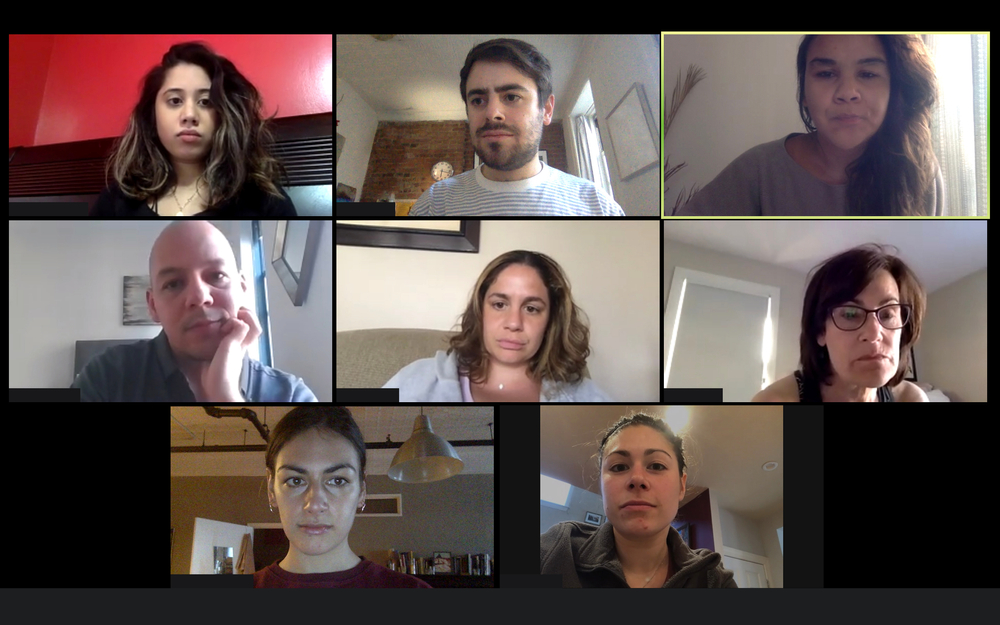
Like a Phone on a Flight: Why Video Calls Drain Your Body and Your Voice
Video calls strip away the cues your body reads in a room. Here's why that leaves you fidgety, loud, and hoarse, and what to do about it.