.webp)
From the Ground Up: How Your Feet Shape Your Breath and Voice
Tension travels. How the feet, psoas, and diaphragm connect along the Deep Front Line, plus three slow practices to free your breath and voice.
.webp)

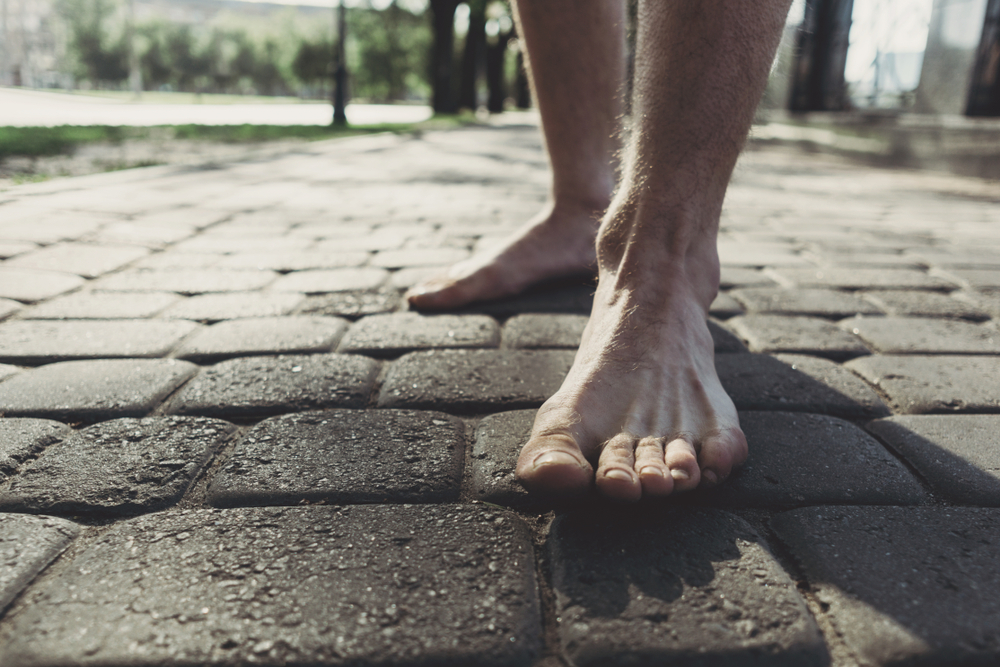
Years ago, I had a client, let's call her Claire. Claire told me her voice felt "stuck somewhere around my chest" We worked on breath. We worked on resonance. We worked on releasing her jaw. We worked on upper body mobility. Progress came, but slowly. Then, almost in passing, Claire mentioned she'd been suffering from plantar fasciitis for months and had been leaning forward, gripping her toes, to alleviate the heel pain.
That detail changed the conversation. The voice is produced in the larynx, but it is powered and shaped by the whole body, and tension rarely stays where it starts. We changed direction and Claire's breathing and voice function improved very quickly after that. It was the last time I began oral communication work without focusing on alignment first. Claire became the first client of my integrated oral communication practice.
TL;DR: The body isn't a stack of separate parts. Connective tissue links muscles into continuous lines, and one proposed line, the Deep Front Line, runs from the big toe through the arches of the feet through the inner legs to the psoas and on through the diaphragm and up into the tongue. The psoas and the diaphragm share real, well-documented anatomical neighbors at the lumbar spine, and the diaphragm does double duty for posture and breathing. That means holding patterns lower in the body can compete with the breath that powers your voice. The research on how far tension travels along these lines is still developing, so I'll show you where it's solid and where it's still a working model. Then I'll offer three slow practices that start at the ground.
Tension doesn't stay put
Most of us think about the body the way an anatomy chart draws it: individual muscles, each with a beginning and an end. But muscles are wrapped in and connected by fascia, a continuous web of connective tissue. Pull on one part of that web, and other parts feel it.
Bodyworker and anatomist Thomas Myers mapped these connections into what he calls myofascial meridians, or Anatomy Trains: lines of muscle and fascia that work together across the body (Myers, 2020). This framework is widely used in manual therapy and movement training, and it gives us a useful language for something many of us feel in practice: that a problem in one place often shows up somewhere else.
Meet the Deep Front Line
Of all Myers' lines, the Deep Front Line is the one I find most relevant to voice work. As he describes it, it begins deep in the sole of the foot, travels up through the deep calf muscles behind the shin, continues along the inner thigh, connects to the pelvic floor and the psoas, and continues upward past the diaphragm toward the deep structures of the neck and tongue (Myers, 2020).
In other words, it's a line that runs through the core of the body, from the feet you stand on to the region surrounding your larynx, terminating at the tongue.
Years ago, I saw a cadaver lab video. In it the supervising doctor pulled the fascia from the big toe creating an immediate Psoas response, then as he pulled further from the Psoas, I saw the entire diaphragm open up like a sail. I’ve never forgotten it.
What the research shows, and what it doesn't
I want to be careful here, because this is a place where physiological information on the web often overreaches.
When researchers systematically reviewed cadaver dissection studies to test six of Myers' lines, they found strong evidence of continuous connective-tissue links for some of them, moderate evidence for others, and no evidence for one (Wilke et al., 2016). The Deep Front Line was not among the lines that review examined, and it remains less thoroughly verified than the strongest lines. The video I mentioned notwithstanding, there is no depth of study (pardon the pun) for this structure.
Some of this has been tested directly. In one small pilot trial, rolling the soles of the feet with a tennis ball led to improved flexibility in the hamstrings and lower back, an effect far from where the rolling happened (Grieve et al., 2015). A later study that rolled just one foot didn't find that kind of distant effect (Grabow et al., 2017). So the remote effects of foot work are real enough to take seriously and inconsistent enough that I won't promise them.
What is not in question is the neighborhood at the top of the chain.
Where the psoas meets the breath
The psoas major attaches along the lumbar spine and runs down through the pelvis to the inner thigh. It's a major hip flexor and helps stabilize the lower back. The diaphragm, your primary breathing muscle, anchors into that same place. Its two muscular "legs," the crura, attach to the upper lumbar vertebrae, and a band of connective tissue called the medial arcuate ligament arches directly over the top of the psoas to give the diaphragm another point of attachment (Standring, 2020).
These are next-door neighbors that share anchoring points and connective tissue
There's a second layer to this. The diaphragm isn't only a breathing muscle. Research by Paul Hodges and Simon Gandevia showed that it also contracts to help stabilize the trunk during movement, adjusting pressure inside the abdomen while it continues to drive the breath (Hodges & Gandevia, 2000). It's doing two jobs at once.
Here's where my clinical observation comes in. When something lower in the body is unstable or guarded, such as a painful foot, a locked ankle, or a chronically gripping hip flexor, the body has to find stability somewhere. In the people I work with, that often looks like a trunk that braces, a belly that won't release on the inhale, and a breath that stays high and shallow. For a speaker, that shows up as a voice that sounds pushed, thin, or short of support.
I can't hand you a study showing that sore feet cause a tight psoas, which causes a restricted diaphragm. What I can tell you is that the anatomy connects them, the diaphragm is already balancing posture against breath, and releasing tension from the ground up is one of the gentlest, lowest-risk places to begin. I will also tell you that twenty years of observation in my practice shows that working from the ground up definitely significantly improves results.
Three practices, from the ground up
Work through these slowly and without force. If you have persistent foot pain, a recent injury, or pain that worsens with any of these, check in with a physician or physical therapist first.
1. Foot rolling
- Standing or seated, place a tennis ball under one foot. (There are specific physio balls available for this purpose - smooth and spikey and a golf ball also works well).
- Let some of your weight settle into the ball and roll it slowly from heel to the base of the toes, then side to side across the arch.
- When you find a tender spot, pause and breathe there rather than pressing harder.
- Spend about two minutes on each foot. (Grieve et al. used two minutes per foot in their trial.)
Afterward, stand on both feet and notice. Do your feet feel broader? Is there any change in how your weight settles?
2. Ankle dorsiflexion
Dorsiflexion is the movement that brings your shin forward over your foot, the motion your ankle makes every time you step or squat.
- Stand facing a wall with one foot a few inches away from it.
- Keeping your heel on the floor, slowly bend that knee toward the wall.
- Go only as far as your heel can stay down. Pause, breathe, and return.
- Repeat slowly several times, then switch sides.
Notice whether one ankle is stiffer than the other. That asymmetry is information, not a problem to fix in one session.
3. Constructive rest for the psoas
The psoas is buried deep in the body, and you can't directly stretch or massage it in any precise way on your own. What you can do is give it a position where it doesn't need to work. This semi-supine position, sometimes called constructive rest, comes from the work of movement educator Lulu Sweigard (Sweigard, 1974) and will be familiar to anyone who has done Fitzmaurice Voicework or Alexander Technique.
- Lie on your back with your knees bent and your feet flat on the floor, about hip-width apart. A thin book under your head is fine if your chin tips up.
- Let your knees lean gently toward each other so your legs can rest without effort.
- Rest your hands on your lower ribs or belly.
- Do nothing. Let the floor hold you. Notice your breath without changing it.
- Stay for five to ten minutes if you can.
Over time, many people notice the breath dropping lower and the belly and back ribs moving more freely. When you're ready to get up, roll onto your side first and take your time.
Bring it back to the voice
After any of these, stand and let out a long, easy hum on a comfortable pitch. Then speak a sentence or two out loud. Listen to how it sounds and notice how it feels in your body compared with before. You may find your voice sits lower and feels less effortful. You may notice nothing yet. Both are useful information.
Start at the ground
When the voice feels stuck, it's tempting to work only where the sound comes out. Sometimes the more useful question is: what is this voice standing on?
Your breath depends on a diaphragm that is also helping you stay upright. Your stability depends on a chain that starts at your feet. Giving that chain a little attention, slowly and without force, can give your breath room to do its job and your voice something solid to stand on.
Additionally, there is no more confident presentation that one taken in connection with your physical structure.
Want to understand how your body is shaping the way you sound? Book a consultation to talk about voice and communication coaching for you or your team.
For a deeper look at how the body shapes the way we lead and speak, download The Body Leads.
References
Grabow, L., Young, J. D., Byrne, J. M., Granacher, U., & Behm, D. G. (2017). Unilateral rolling of the foot did not affect non-local range of motion or balance. Journal of Sports Science and Medicine, 16(2), 209–218.
Grieve, R., Goodwin, F., Alfaki, M., Bourton, A. J., Jeffries, C., & Scott, H. (2015). The immediate effect of bilateral self myofascial release on the plantar surface of the feet on hamstring and lumbar spine flexibility: A pilot randomised controlled trial. Journal of Bodywork and Movement Therapies, 19(3), 544–552.
Hodges, P. W., & Gandevia, S. C. (2000). Changes in intra-abdominal pressure during postural and respiratory activation of the human diaphragm. Journal of Applied Physiology, 89(3), 967–976.
Myers, T. W. (2020). Anatomy trains: Myofascial meridians for manual therapists and movement professionals (4th ed.). Elsevier.
Standring, S. (Ed.). (2020). Gray's anatomy: The anatomical basis of clinical practice (42nd ed.). Elsevier.
Sweigard, L. E. (1974). Human movement potential: Its ideokinetic facilitation. Harper & Row.
Wilke, J., Krause, F., Vogt, L., & Banzer, W. (2016). What is evidence-based about myofascial chains: A systematic review. Archives of Physical Medicine and Rehabilitation, 97(3), 454–461.
Sign up for the GROW Voice newsletter to receive updates on new blog posts, upcoming workshops, and voice training resources delivered directly to your inbox.

Related posts
From the Ground Up: How Your Feet Shape Your Breath and Voice
Tension travels. How the feet, psoas, and diaphragm connect along the Deep Front Line, plus three slow practices to free your breath and voice.