.webp)
Like a Phone on a Flight: Why Video Calls Drain Your Body and Your Voice
Video calls strip away the cues your body reads in a room. Here's why that leaves you fidgety, loud, and hoarse, and what to do about it.
.webp)

Like a Phone on a Flight: Why Video Calls Drain Your Body and Your Voice
You know what happens when you forget to switch your phone to airplane mode. It spends the whole flight searching for a tower that isn't there. By the time you land, the battery is nearly gone, and you didn't even use it.
That is what many of us are doing on video calls. Our bodies keep searching for signal.
In a room with other people, we take in a steady stream of information we never consciously register: a shift in someone's weight, a breath before they speak, the small lean that says "I'm about to jump in." On a screen, most of that is flattened, delayed, or missing entirely. The search for it doesn't stop. It just gets more expensive.
TL;DR: Video calls remove many of the sub-verbal cues our nervous systems rely on to feel oriented with other people, so the body works harder to find them. Research links this to higher cognitive load, disrupted conversational timing, and a measurable tendency to speak louder when visual cues degrade. In my coaching work, I also see more fidgeting, collapsed posture, and shallow breathing on camera, all of which fatigue the voice. The fix isn't more willpower. It's giving your body the sensory information it's looking for, through touch, movement, and deliberate noticing.
What your body is missing
Stanford researcher Jeremy Bailenson laid out four likely contributors to what became known as "Zoom fatigue": excessive close-up eye contact, increased cognitive load, constantly seeing yourself on screen, and reduced physical mobility. His point about cognitive load is the heart of it. In person, we send and interpret nonverbal cues without effort. On a call, we have to work at both. Bailenson is careful to note that his arguments are grounded in existing theory and research but still need direct testing in the video-call context. They are, however, a strong match for what people describe.
There's also the matter of timing. Linguist Julie Boland and her colleagues at the University of Michigan compared conversations held in person and over Zoom and found that the handoff between speakers took longer on video. Even very short transmission lags, well below what most of us would notice, seemed to throw off the rhythm of turn-taking. Boland's proposed explanation is that our brains sync to each other's speech rhythm to time when to start talking, and that small, variable delays disrupt that syncing. She frames the neural piece as promising rather than settled. The practical takeaway holds either way: on video, the dance of conversation is harder to follow, and that costs energy.
So the body does what bodies do when the signal is weak. It searches harder.
What the searching looks like
You get louder. Researchers at the Max Planck Institute for Psycholinguistics and Radboud University had pairs of people talk over video while the picture was gradually blurred. As visibility dropped, people adjusted their gestures, and they also raised their voices. Among participants who were gesturing, volume rose by up to 5 decibels. The authors read this as speech stepping in to make up for a weakened visual channel. Nobody decided to be louder. Their bodies compensated on their own.
That matters for your voice. Speaking louder than usual for long stretches increases what voice scientists call vocal dose, the total amount of work your vocal folds do. Over a day of back-to-back calls, that adds up to the scratchy, tired voice so many people notice by late afternoon.
You fidget. Bailenson points out that video keeps us pinned inside a small frame, when we are built to move as we talk. In my work with clients, I see the restlessness come out sideways: the bouncing knee, the pen clicking, the constant adjusting.
Your posture folds and your breath shortens. This is something I see consistently in coaching. As people lean toward the screen and settle into the chair, the torso collapses and the breath gets shallow and/or breath holding increases. A voice running on inadequate breaths has to push to be heard, which makes the loudness problem worse as it recruits muscles that should not be working so hard.
Put those together and you have someone working hard to connect, getting less back, and paying for it in their body and their voice.
Give your body the signal it's looking for
If the problem is a body searching for sensory information, part of the answer is to supply some. These are the practices I teach most often for video-heavy days. Treat them as experiments and keep what works for you.
Use your hands, off camera. Run your palms slowly down the tops of your thighs. Squeeze your forearms, one and then the other, with firm, even pressure. These are small, private ways to tell your body where it is in space, and nobody on the call has to know.
Keep something in your hand. A stress ball, therapy putty, a smooth stone, anything with texture or resistance you can move without looking at it. Giving the fidget a job is better than letting it find one.
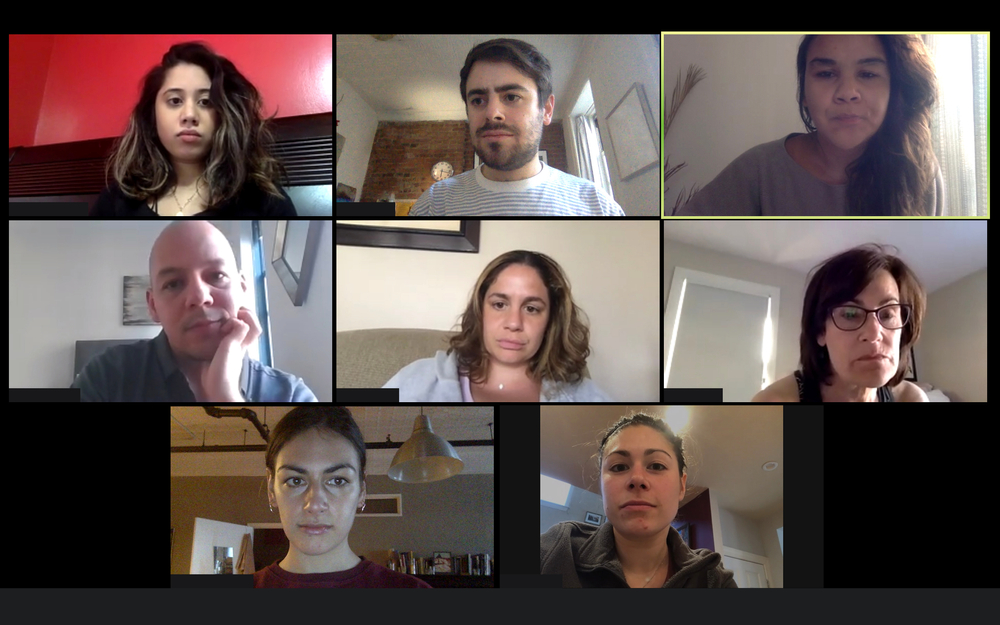
Notice specific people and their scenes. Instead of scanning the whole grid, pick one person and actually look. What colors are they wearing? Is there a mug in reach, a water glass, nothing at all? What's on the wall behind them? This swaps vague, anxious scanning for curious, concrete noticing, which gives your attention something to rest on and makes a connection.
Make the faces smaller. One of Bailenson's own suggestions is to take the call out of full screen so faces take up less of your field of view. It reduces the sense that a crowd of people is inches from your face, especially on a large call.
Let your turns breathe. Boland observed that people on video tend to adapt by taking longer turns, since every handoff carries extra friction. You can do this on purpose. Finish your thought fully, pause, and let the other person come in, rather than racing to catch the gap.
Reset your breath before you speak. Before a call, or during a moment when you're muted, sit back, let your ribs widen, and take a slow breath low into the body. A few minutes of gentle humming or a straw glide between calls can also help your voice recover from the extra effort.
The bigger picture
None of this means video calls are bad or that you're doing them wrong. It means your nervous system is doing its job: looking for the cues that tell it you are connected and oriented with other people. When those cues are thin, it works overtime.
You can't put the signal back into the screen but you can stop leaving your body to search for it alone.
Want help building communication habits that hold up on screen and in the room? Book a consultation.
For more on how the body shapes the way we lead and speak, download my ebook, The Body Leads.
References
Bailenson, J. N. (2021). Nonverbal overload: A theoretical argument for the causes of Zoom fatigue. Technology, Mind, and Behavior, 2(1). https://doi.org/10.1037/tmb0000030
Boland, J. E., Fonseca, P., Mermelstein, I., & Williamson, M. (2022). Zoom disrupts the rhythm of conversation. Journal of Experimental Psychology: General.
Trujillo, J. P., Levinson, S. C., & Holler, J. (2022). A multi-scale investigation of the human communication system's response to visual disruption. Royal Society Open Science, 9(4), 211489. https://doi.org/10.1098/rsos.211489
ENT Today. Article on vocal loudness, vocal dose, and video calls. https://enttoday.org/?p=19109 [Steps You Should Take to Protect Your Voice and Hearing During Telemedicine Sessions by John Parsons, AuD, M. Eugenia Castro, MS, CCC-SLP, Lauren Timmons Sund, MS, CCC-SLP, Alaina Bassett, AuD, PhD, and Rebecca Lewis, AuD • January 15, 2021]
Sign up for the GROW Voice newsletter to receive updates on new blog posts, upcoming workshops, and voice training resources delivered directly to your inbox.

Related posts
Like a Phone on a Flight: Why Video Calls Drain Your Body and Your Voice
Video calls strip away the cues your body reads in a room. Here's why that leaves you fidgety, loud, and hoarse, and what to do about it.